
The ten stages of a Vibecop audit
What happens between handing over repository access and receiving the roadmap, in order.
Repository & architecture discovery
We take read access and map what is actually there: services, routes, jobs, schemas, environments, and the third parties the system depends on. AI-built codebases routinely contain features nobody remembers requesting, so the map is built from the code rather than from a description of it.
Output: A component and dependency map of the system as built.
Automated code & security analysis
Static analysis, dependency and CVE scanning, secret detection, and pattern matching run across the whole repository and its infrastructure config. This pass is deliberately broad and noisy: its job is to miss nothing, not to be right about everything.
Output: A raw finding set, unfiltered, with locations.
Architecture & data-flow tracing
We trace the paths that matter end to end (signup, payment, upload, anything that writes money or personal data), following each one from entry point to storage. Coupling, ownership, and the work happening on the request path become visible here rather than in a diagram.
Output: Traced critical paths, with coupling and bottlenecks marked.
Authentication & authorization review
Authentication is checked for session handling, token lifetime, revocation, and the reset and OTP flows generated last. Authorization is checked endpoint by endpoint, because generated code produces correct login screens far more reliably than it produces correct permission checks behind them.
Output: Per-endpoint access-control findings, including unreferenced routes.
Database & API review
Schema, constraints, indexes, migrations and row-level policies are read against the queries the application really makes. On the API side: input validation, rate limiting, mass assignment, error verbosity, and what the public client key can reach when someone calls the database directly.
Output: Data-layer and API findings, with tenant isolation verified or not.
AI/LLM-specific risk analysis
Where the product runs models in production, we review the context pipeline, tool permissions, memory and retrieval scoping, output handling, spend limits, and failure behaviour. Prompt injection is tested as an access-control problem, because that is what it is.
Output: Agent and LLM risk findings, with tool permission scope assessed.
Infrastructure & deployment review
Hosting, networking, IAM, storage permissions, environment separation, build reproducibility, migration safety and rollback. We also check what happens when a deploy fails halfway, because that is the failure most teams have never rehearsed.
Output: Infrastructure findings plus a deployment and rollback assessment.
Human verification
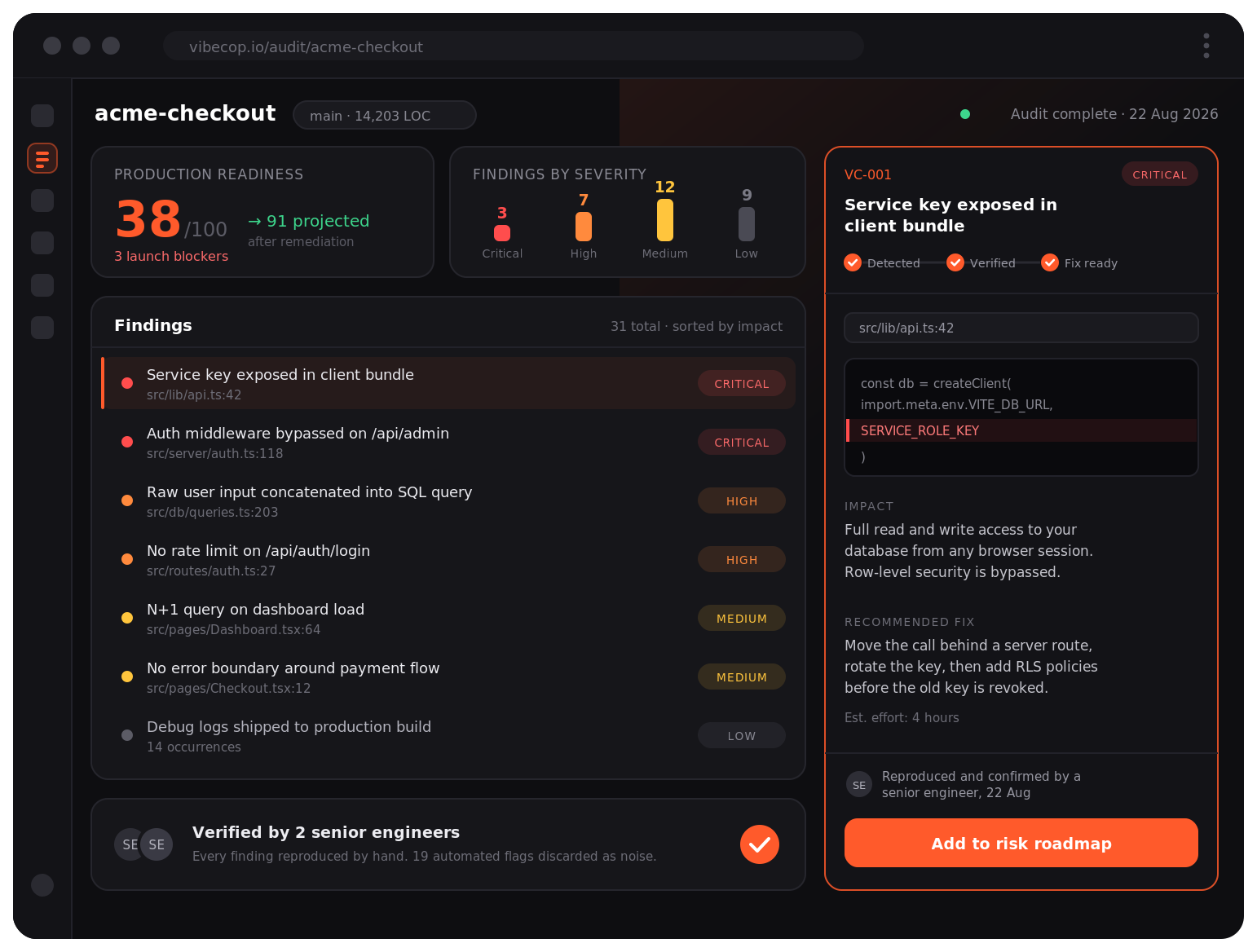
A senior engineer reproduces every finding by hand. False positives are cut, duplicates merged, and anything the tooling missed but the earlier tracing implied gets added. Nothing reaches a client report without a person having confirmed it in the actual codebase.
Output: A verified finding set. Confirmed issues only.
Risk prioritization
Each verified finding is ranked by exploitability and business impact rather than by severity score in isolation. A critical CVE in an unreachable code path ranks below a missing authorization check on your billing endpoint, and we say why in the report.
Output: Findings ordered by real risk, with the reasoning shown.
Remediation roadmap
The prioritized findings become a sequence your team can execute, ordered so fixes unblock each other instead of competing for the same sprint. It is delivered in a live walkthrough with the engineer who wrote it, so the reasoning survives the handoff.
Output: A sequenced fix roadmap, walked through live.
The 3-7 Business Day Production Readiness Plan
Typical scope-to-handoff time in business days. Larger or more tangled codebases run longer, and we tell you which side of the window you are on up front.
Day 0: Scope & Access
We map your repo, your stack, and what ships next. The audit is scoped against your actual launch risk, not a generic checklist.
Days 1-2: Automated Analysis
Machine-speed analysis across architecture, codebase, infrastructure config, and security posture. Every structural risk and anti-pattern gets surfaced.
Days 3-5: Senior Engineer Verification
Every finding is reproduced and validated by hand. False positives cut, severity assigned against your business context rather than a CVSS score in isolation.
By day 7: Risk Roadmap Handoff
A prioritized fix list your team can execute, walked through live with the engineer who wrote it.
Handoff kit
Everything your team needs to act on the audit what we found, in what order to fix it, and a live walkthrough.
Findings
Every issue with impact and a fix.
Roadmap
Sprint-by-sprint fix sequence.
Walkthrough
Live session with your engineer.
Build with
confidence.
AI builds the product. Vibecop makes sure it won’t break in production, fail under scale, or expose your users to risk. One audit. Fewer expensive surprises.